

The Algorithms Lab launches the new PHOEG web interface for Research and Education in Graph Theory
 The Algorithms Lab is proud to announce the release of a completely redesigned web interface for PHOEG (PHOEG Helps to Obtain Extremal Graphs), an interactive online tool designed to assist researchers and educators in graph theory. This release coincides with the submission of our latest preprint detailing the platform’s architecture and applications.
An Exact Geometrical Approach Unlike tools that rely on heuristic or probabilistic methods, PHOEG commits to an exact geometrical approach. It embeds graphs into a two-dimensional invariant space and computes their convex hull. In this mathematical space, the facets of the resulting polytope represent linear inequalities between the chosen invariants, while the vertices correspond to the extremal graphs.
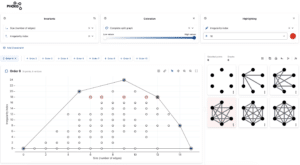 What’s new in this version? The new platform provides seamless access to a massive database of approximately 34 million pairwise non-isomorphic graphs, encompassing all graphs up to order 10.
-
For researchers: The interface allows for complex explorations using numerical constraints, colorations, and highlighting. It acts as a powerful catalyst for forming new mathematical conjectures, finding counterexamples, and building structural intuition. Additionally, a standalone RESTful API is now available for automated, programmatic access to the database.
-
For educators: The platform features a comprehensive suite of built-in interactive tutorials. It is already being actively used in advanced graph theory courses at the University of Mons and Polytechnique Montréal to help students empirically rediscover classical theorems.
Explore the tool and the research:
-
🌐 Try the web interface: https://phoeg.umons.ac.be
-
📄 Read the preprint on arXiv: https://arxiv.org/abs/2603.27242
Authors: Sébastien Bonte, Gauvain Devillez, Valentin Dusollier, and Hadrien Mélot.