UMONS logo – University of Mons
  • Directory
  • fr
  • fr
  • en
  • Expertise and research topics
  • Noteworthy Activities and Developments
  • Community Services
  • List of units
  • Members
  • Flagship Projects
  • Publications of the Research Institute for BIOSCIENCES
  • PhD theses available
  • Post-doc topics available
  • Our networks
    • Intranet
Go back to UMONS Website UMONS
  • Expertise
  • Members
Institut / Biosciences
  • Flagship Projects
  • Home Research
Back to all news
  1. Home
  2. Purple bacteria : a new hope for sustainable food systems ?

Purple bacteria : a new hope for sustainable food systems ?

Published on 11 June 2025
Written by Damiano Di Stazio
The future of our food systems likely depends on innovation and the valorization of underexploited resources. The Purple4Life project, coordinated by the Proteomics and Microbiology Department at UMONS (Prof. Ruddy Wattiez) and funded by the Horizon Europe programme, is exploring a promising solution: using purple bacteria to produce innovative, nutrient-rich, and environmentally friendly ingredients.

The Purple4Life initiative, coordinated by UMONS with support from its European Project Office, is built on the potential of purple bacteria, which can convert agri-food by-products into high-value nutritional compounds. According to Baptiste Leroy, researcher at the Proteomics and Microbiology Department of UMONS (Prof. Ruddy Wattiez) :

“Purple bacteria have a high protein content (>50%) of excellent quality and are already being studied as an alternative protein source. Their main advantage lies in their ability to grow on a wide range of carbon sources, including industrial by-products such as molasses or whey”.

Beyond their protein richness, these bacteria stand out for their exceptionally high content of coenzyme Q10 (CoQ10) and carotenoids—compounds with strong antioxidant properties, beneficial to both human and animal health.

Multiple applications in health and aquaculture

One of the main focuses of the Purple4Life project is to explore how Coenzyme Q10 could serve as a natural dietary supplement, particularly for elderly individuals or those with deficiencies. At the same time, researchers are investigating the potential of carotenoids as a sustainable alternative to synthetic additives currently used in aquaculture.

“We will also analyze the psychological barriers to the use of this new type of food,” explains Baptiste Leroy. “In addition, the use of purple bacteria as a feed additive for salmonids will be tested”.

The success of the project hinges on a major technical challenge: achieving pilot-scale production within the next two years. This key milestone will allow the team to validate the health benefits of purple bacteria and meet regulatory requirements—essential steps before any move toward industrialization.

A step toward sustainable and innovative food systems

By transforming by-products into nutrient-rich food ingredients, the Purple4Life project fully aligns with the ambitions of the Farm to Fork strategy and European food security goals. A comprehensive life cycle analysis will also be conducted to ensure the environmental footprint of the process is minimized.

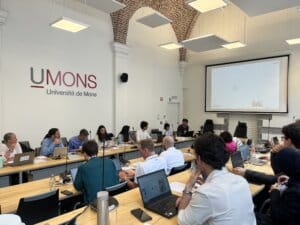
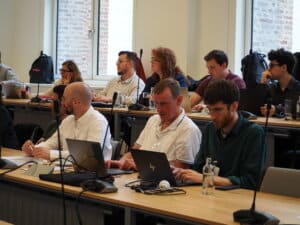
The project’s official launch event took place on June 10 and 11 at UMONS, bringing together all partner institutions.
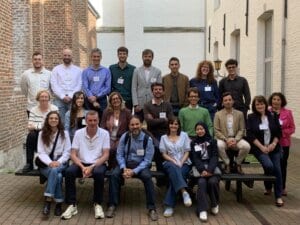
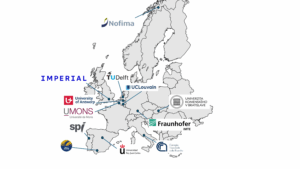
Purple4Life is a European project funded under a HORIZON Research and Innovation Action (RIA) – Circular Bio-Based Europe Joint Undertaking (CBE JU). It is coordinated by UMONS, in collaboration with the following partners: UAntwerp, TU Delft, Universidad Rey Juan Carlos, Consiglio Nazionale delle Ricerche (CNR), UCLouvain, Imperial College London, Nofima, Pablo de Olavide University, Fraunhofer Institute, SPI – Sociedade Portuguesa de Inovação, and Comenius University of Bratislava.


  • Facebook
  • LinkedIn
  • Print

Post navigation

Next Next post: UMONS secures a WEAVE project to uncover the secrets of mechanical memory in migrating cells

In connection with what you have just read

  • 13 July 2026

    When Cameroon’s biodiversity inspires an environmentally friendly alternative to pesticides

  • 22 June 2026

    UMONS secures a WEAVE project to uncover the secrets of mechanical memory in migrating cells

Featured news

  • When Cameroon’s biodiversity inspires an environmentally friendly alternative to pesticides
    Recherche

    When Cameroon’s biodiversity inspires an environmentally friendly alternative to pesticides

    13 July 2026
    In Cameroon, fruit losses before and after harvest remain a major challenge for many producers. To help reduce reliance on chemical pesticides, an ARES-funded valorisation project brings together the UMONS Laboratory of Ecology of Interactions and Global Change, headed by Kévin Tougeron, and the University of Douala. Together, the partners aim to harness the natural properties of essential oils derived from Cameroon’s flora to develop a more sustainable biocontrol solution for protecting fruit crops. Continue reading
  • UMONS secures a WEAVE project to uncover the secrets of mechanical memory in migrating cells
    Recherche

    UMONS secures a WEAVE project to uncover the secrets of mechanical memory in migrating cells

    22 June 2026
    The SYMBIOSE laboratory at UMONS, led by Professor Sylvain Gabriele, has secured funding of nearly €340,000 as part of a WEAVE project supported by the F.R.S.-FNRS and the Swiss National Science Foundation (SNSF). Conducted in collaboration with Professor David Brückner, from the University of Basel, this project aims to better understand how cells retain the mechanical memory of their environment and use this information to guide their future movements. Continue reading
  • ULB-UMONS Study Explains the Influence of Nectar Sweetness on Bees' Foraging Ability

    ULB-UMONS Study Explains the Influence of Nectar Sweetness on Bees' Foraging Ability

    03 May 2021
    This study has just been published in the American journal "PNAS". Researchers looked at the fluid capture mechanism in bees to show that it is only effective if the nectar is not too sweet. Continue reading
UMONS logo
Belgium
Tel.: +32(0)65373824
General contacts
© UMONS 2026
Chatbot UMONS Uguette, your virtual assistant
NEW : Talk with Uguette, your virtual assistant!
Uguette, your virtual assistant