Logo de l'UMONS – Université de Mons
  • Répertoire
  • EN
  • FR
  • EN
  • Accueil
  • Actualités du service
  • Agenda du service
  • Activités d’enseignement
  • Activités de recherche
    • Publications
  • Équipe
  • Contacter le service
  • Nos réseaux
    • Intranet
Retourner sur le site web de l'UMONS UMONS

Service / FS – Synthèse et Spectrométrie de Masse Organiques

Retour à « Toutes les nouvelles »
  1. Accueil
  2. Congratulations, Dr Duez !
Alumni

Congratulations, Dr Duez !

Publié le 29 septembre 2020
Rédigé par Eric Weverbergh
On Friday September 25, Quentin DUEZ has defended his PhD thesis entitled “Gas-Phase Structure of Polymer Ions : Ionization, Relaxation, and Implications for Structural Characterization”.
Congratulations, Dr Duez !

On Friday September 25, Quentin DUEZ has defended his PhD thesis entitled “Gas-Phase Structure of Polymer Ions : Ionization, Relaxation, and Implications for Structural Characterization”.

The PhD thesis jury was composed by Prof Claudio Zannoni (University of Bologna), Prof Carlos Afonso (Université de Rouen), Prof Philippe Dubois (UMONS), Dr Kevin Giles (Waters, UK), Prof Roberto Lazzaroni (UMONS), Prof Jérôme Cornil (UMONS), and Prof Pascal Gerbaux.

Quentin will now move for one year at the Radboud University in Nijmegen, as a post-doctoral researcher in the group of Prof Jana Roithova.

Congratulations for this work well done !
  • Facebook
  • LinkedIn
  • Imprimer

Navigation de l’article

Précédent Poste précédent : Congratulations, Dr Colson !
Suivant Poste suivant : New paper on the analysis of isomeric homo and copolymers by ion mobility mass spectrometry

En lien avec ce que vous venez de lire

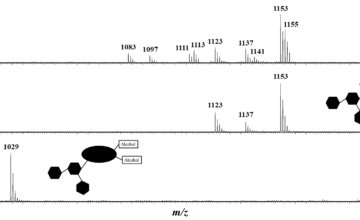
  • MALDI mass spectra (positive ionization mode) of three different saponin extracts: (a) Natural extract (NE); (b) Escins I, II and III enriched-extract (EE) obtained by flash chromatography separation (non-polar column–acetonitrile gradient); (c) Microwave-assisted alkaline hydrolysis (pH 14–150 °C–5 min) reaction extract (HE). The molecular structures are schematized by highlighting the targeted functions: in EE saponins, the esters are located on C21 (Tig or Ang) and C22 or C28 (Ac); in the HE saponins, the hydrolysis products possess alcohol groups on C21, C22, and C28.
    23 février 2023

    Horse Chestnut Saponins–Escins, Isoescins, Transescins, and Desacylescins

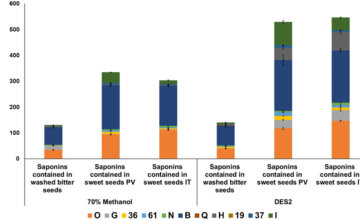
  • Relative amounts of saponins identified in the samples: water-washed bitter seeds, sweet seeds PV, and sweet seeds IT, extracted either with 70% methanol or DES2 (choline chloride - glycerol - water at a molar ratio 1:2:1). The solvent/sample ratio is 20:1 (w/w) to all samples. The structures of the different saponins are described in Table 1 n = 3 technical replicates.
    20 août 2022

    Deep eutectic solvents for the extraction and stabilization of Ecuadorian quinoa (Chenopodium quinoa Willd.) saponins

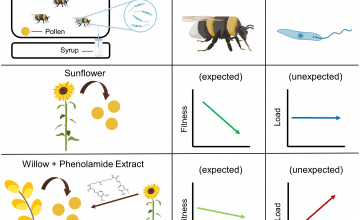
  • Poison or Potion: Effects of Sunflower Phenolamides on Bumble Bees and Their Gut Parasite
    24 mai 2022

    Poison or Potion: Effects of Sunflower Phenolamides on Bumble Bees and Their Gut Parasite

Actualités

  • Horse Chestnut Saponins–Escins, Isoescins, Transescins, and Desacylescins
    Non classé

    Horse Chestnut Saponins–Escins, Isoescins, Transescins, and Desacylescins

    23 février 2023
    Escins constitute an abundant family of saponins (saponosides) and are the most active components in Aesculum hippocastanum (horse chestnut—HC) seeds. They are of great pharmaceutical interest as a short-term treatment for venous insufficiency. ... Poursuivre la lecture
  • Deep eutectic solvents for the extraction and stabilization of Ecuadorian quinoa (Chenopodium quinoa Willd.) saponins
    Non classé

    Deep eutectic solvents for the extraction and stabilization of Ecuadorian quinoa (Chenopodium quinoa Willd.) saponins

    20 août 2022
    In this work, a simple, fast (10 min) and environmentally friendly extraction method using deep eutectic solvents (DES), based on choline chloride and glycerol, was established to extract saponins from five quinoa samples... Poursuivre la lecture
  • Poison or Potion: Effects of Sunflower Phenolamides on Bumble Bees and Their Gut Parasite
    Non classé

    Poison or Potion: Effects of Sunflower Phenolamides on Bumble Bees and Their Gut Parasite

    24 mai 2022
    In this work, we tested the impacts of sunflower phenolamides on healthy and parasite infected buff-tailed bumble bees. Expectedly, sunflower pollen had harmful consequences on bumble bee development but surprisingly, it did not alter parasite load. By contrast, sunflower phenolamides had milder effects on bumble bee development but unexpectedly increased parasite load. Poursuivre la lecture
UMONS logo
Place du Parc , 20
7000 Mons
Belgique
Tél. : +(32)65 37 31 11
Contacts généraux

Informations destinées à

  • Futur étudiant
  • Enseignant
  • Chercheur & Doctorant
  • Alumni
  • Journaliste

Nos missions

  • Facultés et écoles
  • Partenariats
  • L’UMONS à Charleroi
  • Instituts de recherche
  • Services d’enseignement et de recherche
  • Bibliothèques
  • MUMONS – Sciences, Arts & Curiosités

Accès rapide

  • Bien choisir ses études
  • S’inscrire à l’UMONS
  • Chercher une formation
  • Agenda & Evénements
  • Actualités de l’Université
  • Emploi/Euraxess
  • Plan des campus
  • Lexique
  • Répertoire du personnel
  • Point d’info à l’UMONS
  • Contacts
© UMONS 2026
Chatbot UMONS Uguette, votre assistante virtuelle
NEW : Parler avec Uguette, votre assistante virtuelle !
Uguette, votre assistante virtuelle