Designing a gas turbine capable of operating on hydrogen is not simply a matter of replacing one fuel with another. Flame stability, temperatures and pollutant emissions can all be significantly affected. For industry, anticipating these phenomena from the equipment design stage is a major challenge. This is precisely the issue addressed by Alessandro Piscopo as part of his PhD research conducted jointly at UMONS and the Université libre de Bruxelles (ULB). By developing numerical simulation tools and comparing their predictions with experimental results, his research contributes to a better understanding of hydrogen and ammonia combustion, two fuels being considered for the energy systems of tomorrow.
How can CO₂ capture be improved while limiting its cost and energy consumption? In his PhD research conducted within the Thermodynamics Department of the UMONS Faculty of Engineering, Arnaud Henrotin investigated Metal-Organic Frameworks (MOFs), a new class of porous materials recognised by the 2025 Nobel Prize in Chemistry, capable of adsorbing CO₂ and whose properties can be tailored to different applications. Under the supervision of Dr Nicolas Heymans and Professor Guy De Weireld, he developed and tested a laboratory-scale CO₂ capture pilot unit, before using the results obtained to assess the process at industrial scale through simulation.
Vincent Thielens, a researcher in the Thermal Engineering and Combustion Department at UMONS, has been awarded an Excellence Grant from Wallonia-Brussels International (WBI). Worth €25,000, the grant will enable him to continue his research at the German Aerospace Center (DLR) in Stuttgart, with the aim of making carbon capture more efficient while preserving the flexibility of natural gas power plants.
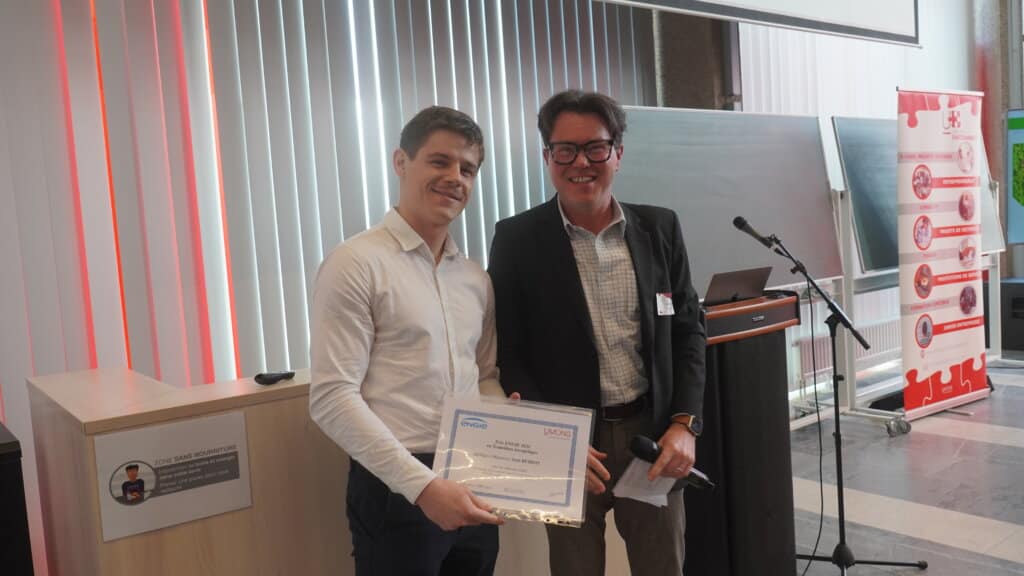
Recipient of the ENGIE Prize 2025, Jean Bériot, a graduate of the Faculty of Engineering at UMONS, was recognized for a thesis devoted to a key issue of the energy transition: how to reduce CO₂ emissions from gas turbines. By comparing two technological solutions, carbon dioxide capture and hydrogen combustion, his work provides both scientific and economic insight into the energy choices of tomorrow, which convinced the ENGIE Prize jury.




 Uguette, your virtual assistant